This attraction introduction is compiled from historical materials in the "Zhangjiajie Tour Guide Network" (33519.com · Scenic Spots section). Ticket prices, opening hours, transportation, and contact information mentioned in the text may be outdated. Please refer to the latest official announcements from the scenic area before traveling; some content consists of historical background/cultural introductions and is for reference only.
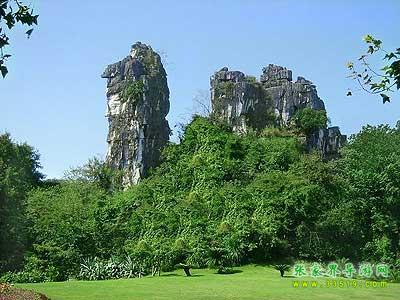
The Xiang River meets the Lian River at Hekou on the western end of Xiangtan. Just as it is about to pour forth with even more majestic momentum, it suddenly encounters a red stone mountain extending from the west bank into the river. The surging river water, like a fierce horse trying to break free from its reins, roars, rolls up snow-white waves one after another and lunges at the stone mountain, then groans as it shatters to pieces and falls back into the river. The red mountain and white waves, like two dragons battling for countless years, attract people year after year, month after month to admire and chant about them. This mountain in the river is the ancient famous mountain that gathers the cultural landscape of Xiangtan City -- Pot Mountain.
Pot Mountain is named for its shape resembling a huge teapot. During the Yongchang period of the Eastern Jin Dynasty, the famous general and inspector Tao Kan stationed troops here, leaving behind many relics, and the people also customarily called it Taogong Mountain. Tao Gong once built a small thatched hut on the mountain and cleared land around it to grow vegetables. On a cliff by the river that looks as if cut by knives and axes, there are four large characters each one meter square reading "Scenic Traces of Rivers and Mountains," carved by the people of the early Tang Dynasty to commemorate Tao Kan's achievements and display the local splendor. Tao Gong's tomb was built behind a nearby hill, with the tombstone inscribed "Tomb of Tao Huan Gong, Inspector of Jin," and the tomb couplet reads: "Rivaling Mount Heng for a thousand autumns without decay; accompanying the Xiang River for ten thousand ages flowing fragrance."
Pot Mountain is shaped like a pot, and the part most resembling it is the spout extending into the center of the river, which people call Shizuinao. It stands abruptly in the Xiang River, over a hundred feet high, entirely red-purple in color, like a fire dragon bursting out of the dragon palace wanting to soar into the nine heavens. Under the impact of the surging river water, the stone spout has left countless scars, which instead add a touch of enchanting charm. Some parts look like strings of pearl curtains, some like protruding Buddha's belly, some like drifting colorful clouds. No wonder Tao Kan often lingered and rested here in his spare time after official duties, and built two pavilions, "one for viewing the mountain, one for fishing."
In the eastern part of Pot Mountain there is a thousand-year-old ancient temple, called Stone Temple in the Jin Dynasty. Beside the temple was a stone pagoda, so it was also called Stone Pagoda Temple. In the early Tang Dynasty, Chu Suiliang, a minister entrusted by Emperor Taizong with his dying wishes, was demoted to Inspector of Tanzhou for opposing Emperor Gaozong's installation of Wu Zetian as empress. Filled with anger and concern for the country, he wrote a stone plaque "Great Tang Xing Temple" for the Stone Temple, to express his intention of supporting the Tang Dynasty. The Stone Temple was thereafter renamed Tang Xing Temple. Today, the temple buildings have been destroyed, and the "Great Tang Xing Temple" plaque is kept in Tang Xing School as a rare calligraphy carving. Tang Xing Temple has always been a scenic spot, and some even say that "Evening Bell at Misty Temple," one of the Eight Views of Xiaoxiang, is located here. The Tang Xing Bridge beside the temple has a history of a thousand years. Originally named Pot Mountain Bridge, it was renamed after the Tang Dynasty and is the oldest existing stone bridge in Xiangtan City.
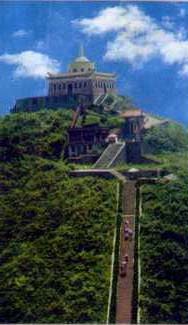
The two pavilions Wangyue and Diaoyu built by Tao Kan at Shizuinao, as well as the later Huangye, Xiangjiang, and Guanxiang pavilions, all collapsed one after another. In 1923, local people built the "Wangheng Pavilion" based on Tao Kan's meaning of "viewing the mountain." The pavilion couplet reads: "The earth's axis and heaven's pillar is this lone stone; mountain colors and river sounds gather in one pavilion." Climbing the pavilion, looking south to Mount Heng, with morning sunlight and blue-green colors, and north to Yuelu Mountain, with layered peaks, you will be overjoyed and linger without wanting to leave. In 1982, Wangheng Pavilion was listed by the Xiangtan Municipal People's Government as a municipal-level key cultural relic protection unit.