This attraction introduction is compiled from historical materials in the "Zhangjiajie Tour Guide Network" (33519.com · Scenic Spots section). Ticket prices, opening hours, transportation, and contact information mentioned in the text may be outdated. Please refer to the latest official announcements from the scenic area before traveling; some content consists of historical background/cultural introductions and is for reference only.
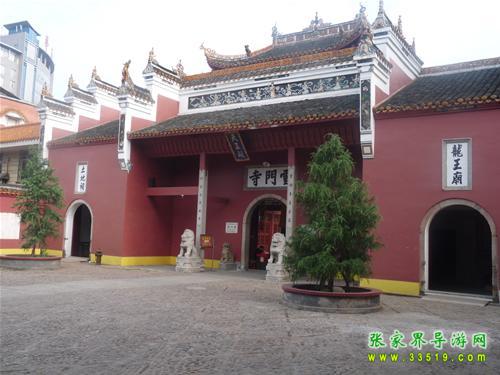
Yunmen Temple is located southwest of the Xiangxiang City Bus Station, beside Dongfeng Road. It was first built in the second year of the Huangyou reign of the Northern Song dynasty (1050 AD). Because there were two stone tablets at the temple gate at that time, clear in color and warm and smooth, said to be jasper produced by Geng Mountain, it was named Shibei Temple. In the ninth year of the Yongle reign of the Ming dynasty (1411 AD), a eminent monk named Cihui came from Yunmen Mountain in Shaoxing, Zhejiang, to live at the temple. At that time, he observed five-colored auspicious clouds reflecting its halls and pavilions, so it was renamed Yunmen Temple.
Yunmen Temple covers about 10 mu. Its main buildings include the Front Hall, Middle Hall, Mahavira Hall, and Guanyin Pavilion. Among them, the Guanyin Pavilion is the most spectacular. The hall and pavilion are 35.4 meters deep, 17.5 meters wide across the front, and about 15 meters high. Three sides bear the load with brick walls, with a double-eaved hip-and-gable roof and upturned corners. Within the double eaves, a skylight is set, allowing viewers to stand in the front courtyard and look up at the Buddha's face through the skylight. Inside the pavilion is a Buddhist shrine, decorated with two large wooden columns painted in vermilion, inscribed with a golden couplet: "Merciful and kindly is the gate of compassion; why should the Buddha be ashamed to be called the compassionate father and the multitude the compassionate mother? Vast and boundless is the sea of life; it truly matches Qian called Great Production and Kun called Broad Salvation." Above the shrine hangs a horizontal plaque inscribed "Nanhai Changchun" (South Sea Everlasting Spring) written by Zeng Guoquan in the sixth year of the Tongzhi reign of the Qing dynasty (1857 AD). In the pavilion is a round bronze flat-bellied incense burner, 0.55 meters in diameter and 0.23 meters high, with a pair of monster-head images cast on the outer belly, extremely exquisite in shape. The Guanyin statue in the pavilion is a mixed structure of clay sculpture and wood carving, covered entirely in gold, 11.4 meters high, the tallest Guanyin statue in Jiangnan. The Buddha stands upright on a lotus throne, with full cheeks, slightly downcast eyes, and a dignified and kindly appearance; the clothing ribbons seem to flutter, the crown ornaments seem to tremble; the hair on both temples can be counted strand by strand; the Buddha mole on the forehead is clearly visible; the ears hang to the shoulders, and the earrings sway; the tip of the nose is slightly upturned, and the lips are slightly parted, as if murmuring Buddhist prayers. On the Buddha's crown are 24 faces, each modeled with a living Buddha; the upper body has a thousand hands, and in each palm is a beautiful eye. Among them are 4 pairs of large hands, either raising the Buddha high, or joining palms to write heavenly script, or waving arms to hold halberds, or bending fingers to calculate—appropriate in size and position; the entire modeling is well-proportioned, exquisitely sculpted, strange and beautiful.
On the corridors on both sides in front of the pavilion are enshrined eighteen Qiyang stone-carved arhats from the nineteenth year of the Guangxu reign of the Qing dynasty (1893 AD). Each is 1.5 meters high and different in appearance—some joyful, some angry, some sorrowful, some happy, some pensive, some gazing intently; the facial muscles and forehead wrinkles are tense with anger, knit with sorrow, relaxed with joy. Psychological changes and bearing and posture are depicted vividly. These artistic treasures are the crystallization of the painstaking efforts of our ancestors. According to the "Record of the Eighteen Arhats Stele," more than a hundred years ago, an eminent monk traveled and begged for alms for decades, enduring countless hardships, and only when his beard and hair had all turned white did he raise the funds to sculpt these eighteen arhats. Those skilled craftsmen then spent a full five years carving and chiseling.
In 1959, the Hunan Provincial People's Committee announced Yunmen Temple as a provincial key cultural relic protection unit. In the same year, the Xiangxiang County People's Government used it as the site of the museum and established the first county-level museum in Hunan Province, asking Mr. Guo Moruo to inscribe the museum name. Later, in the national tourism map drawn by the National Tourism Administration, Yunmen Temple was listed as one of the tourist attractions, receiving more than 100,000 Chinese and foreign visitors each year. In the nearly 40 years since the museum was established, it has collected more than 7,000 cultural relics and materials. According to 1996 statistics, after sorting and re-identification, those named and numbered included 532 pieces of porcelain, 716 pieces of pottery, 414 pieces of calligraphy and painting, 368 pieces of ancient books, rubbings, and documents, 942 pieces of various metal objects, 421 pieces of jade, and 107 pieces of carved handicrafts, among which 7 are first-class items, 17 are second-class items, and 238 are third-class items.