This attraction introduction is compiled from historical materials in the "Zhangjiajie Tour Guide Network" (33519.com · Scenic Spots section). Ticket prices, opening hours, transportation, and contact information mentioned in the text may be outdated. Please refer to the latest official announcements from the scenic area before traveling; some content consists of historical background/cultural introductions and is for reference only.
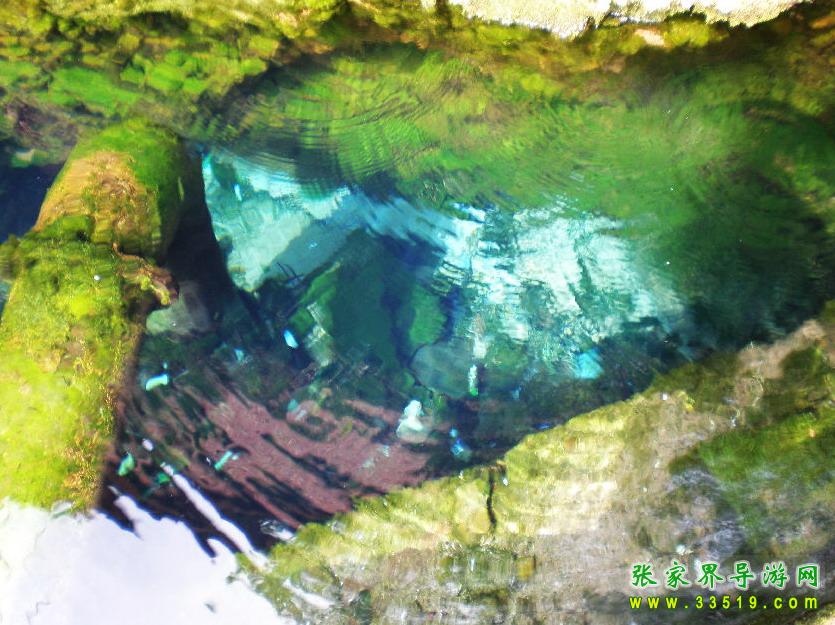
Biquan Pond (Emerald Spring Pond) is located in Jinshi Township, Xiangtan County, about 40 kilometers from Xiangtan City. The Qing Dynasty Jiaqing-era "Xiangtan County Gazetteer" records: "During the Tianbao era of the Tang Dynasty, a spring suddenly gushed out from the rock, colored like indigo. When objects were thrown into the water, they all turned emerald green." Thus the name Biquan (Emerald Spring) originated. In addition, a legend of a malevolent dragon circulated in the central Hunan area: "Head at Tieshu Temple in Jiangxi, tail at Biquan Pond in Hunan. Shake it a bit, sway it a bit, and Hunan will be washed away to become the Central Sea." It is also said that to subdue this malevolent dragon, every Spring Festival iron chains were thrown into Biquan Pond to lock up the evil dragon and ensure Hunan's safety. Thus Biquan Pond became widely renowned.
People say Biquan Pond has three wonders, and this is indeed not fabricated.
First is the wondrous appearance of the spring. The pond surface closely resembles boiling water, with circular ripples spreading ring by ring. An earlier writer described it thus: "The spring emerges from the rocks, churning sand and swirling waves, spiraling upward like a coiled bun." This describes how the upward force of the spring drives the gravel at the bottom into arc-shaped coil patterns that continuously spiral upward. As they near the surface, the force diminishes and they scatter and fall, while the gravel behind forms new coils—repeating endlessly, a remarkable spectacle. Especially under sunlight, the water plants, stones, gravel, and debris at the bottom of the pond are dyed in seven colors, making it incomparably magnificent.
Second is the wondrous water quality. Biquan water maintains a temperature of around 20°C year-round. In the heat of midsummer, approaching the spring brings a sudden refreshing coolness, pleasant to the body; cupping the water and drinking it is mildly sweet and agreeable. In deep winter, steam rises, suitable for washing one's face and feet. Since ancient times, using Biquan water to irrigate rice paddies has produced plump grains shaped like "osmanthus stamens," once presented as tribute grain. Tofu made with Biquan water stays fresh without spoiling for a longer time; ducks raised with Biquan water lay round, solid eggs without gaps; fish raised in it have tender, sweet flesh. In 1984, the Xiangtan County Biquan Pond Aquatic Seed Breeding Farm was established here. That year, tilapia fingerlings were introduced three times for overwintering and spawning breeding experiments, producing 150,000 fry. In the spring of 1986, artificial hatching of catfish was successfully carried out, producing 500,000 fry—a first for Hunan Province. In August 1988, 2,000 freshwater pomfret were introduced from Dongguan City, Guangdong Province, for overwintering experiments, which also succeeded. In recent years, someone has also developed eel production here.
Third is the wondrous habits of the fish in the pond. Just before dawn, large numbers of crabs suddenly surge into the spring, and as soon as the sun rises, they flee without a trace. At midnight when the wind is clear and the moon bright, a school of snakehead fish darts out from the bottom of the spring, each weighing about two to three jin, swimming swiftly like shuttles in the pond. But at the slightest sound, they quickly dive into stone crevices at the bottom and do not emerge again until midnight the next day.
The scenery of Biquan Pond is so magical that since ancient times it has been a wonderful place for people to visit and compose poetry.