This attraction introduction is compiled from historical materials in the "Zhangjiajie Tour Guide Network" (33519.com · Scenic Spots section). Ticket prices, opening hours, transportation, and contact information mentioned in the text may be outdated. Please refer to the latest official announcements from the scenic area before traveling; some content consists of historical background/cultural introductions and is for reference only.
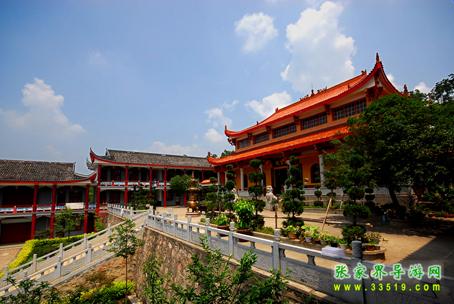
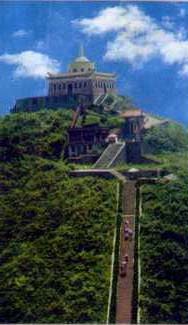
Wulong Mountain lies between the Xiang and Wei rivers. With Tianma coming from the south and the five ridges winding around, it is like five dragons at play. There are deep valleys and sweet springs, dense forests and beautiful ravines, and the scenery is enchanting. According to the "Stele Record of Xiangtan Wulong Mountain" written by Li Chengli in 1929: "Gathering the spirit of Mount Heng, nurturing the beauty of the Xiang River... the five peaks spread out broadly, their forms winding and sinuous, hence they are called the Five Dragons." On Wulong Mountain, ancient trees reach the sky, and clouds and rosy light shine upon one another. The famous temple Dajie Temple in the mountain's belly is located right here.
According to historical records, Dajie Temple was first built in the fifth year of Chongzhen in the Ming Dynasty (1623), when Master Hui'an from Wudang Mountain came here, built a thatched hut, and lived in it. Legend says that the mountain's protector deity, Bodhisattva Xuandi, formerly had his place of practice at Yuewu Pavilion in Zhonglupu. At that time, Emperor Zhengde was sacrificing at the Nanyue Temple and stayed overnight at Yuewu Pavilion. At night he had a dream in which Bodhisattva Xuandi said to him: "Yuewu Pavilion has a rather large coming and going of people, bustling and complicated. I do not wish to reside in this place and want to move to Wulong Mountain." Emperor Zhengde woke with a start from the dream, and the next day went to Wulong Mountain. At the foot of the mountain he happened to encounter a snake leading the way. When he reached a small temple in the mountain's belly, the snake coiled up and went no farther. Only then did Emperor Zhengde realize that Xuandi wished to build a hall here. After returning to the palace, he issued an edict granting 360 mu of incense-offering land and ordered the two vassal kings Ji and Gui to donate funds to build the temple. At the time of its initial construction, there were the Wuzheng Hall, the Yuesheng Hall, the Guanyin Hall, and others. After the three-tier main hall, there were successively added the Wuliang Buddha Hall, the Xilin Chan Hall, the Yunshui Hall, the Donglin Monk Chan Courtyard, and other buildings large and small, more than 120 rooms in all.
Dajie Temple faces south, surrounded by layered peaks and ridges, with deep forests and dense trees whose thick shade blocks the sun. Nearby it embraces Shima and Guyue peaks, and from afar it gazes toward Xiaoxia and Mount Heng. The temperature is moderate, making it a good place for the faithful to seek the Buddha and for escaping the summer heat and cooling off.
During the Great Leap Forward, Dajie Temple was destroyed and looted, and during the Cultural Revolution it suffered further misfortune, at one point being converted into a rural forestry farm. After the period of bringing order out of chaos, with people of integrity and harmony, all neglected undertakings flourished anew. In 1994, a nun named Chunrong entered the mountain, and later the elderly Dharma Master Xiaochang led his disciple Weijing from Tielu Temple in Changsha to reside at the mountain. They went everywhere to seek alms and donations, and rebuilt the great temple. Over several years, at a cost of more than 3 million yuan, they built the Mahavira Hall, the mountain gate, enclosing walls, east and west monks' quarters, the dining hall, and the recitation hall—more than 50 rooms in all. Around the temple, green pines and cypresses once again provided cover, forming shady groves, with birdsong and fragrant flowers. With incense curling upward and wind chimes ringing, it is truly a pure land in this dusty world, a Brahma palace among mortals.
After the reconstruction of Dajie Temple, with the approval of the Xiangtan County People's Government, the temple has been listed as a key Buddhist activity site in Xiangtan City, and two roads have been built from the entrance outside the mountain directly to the temple.
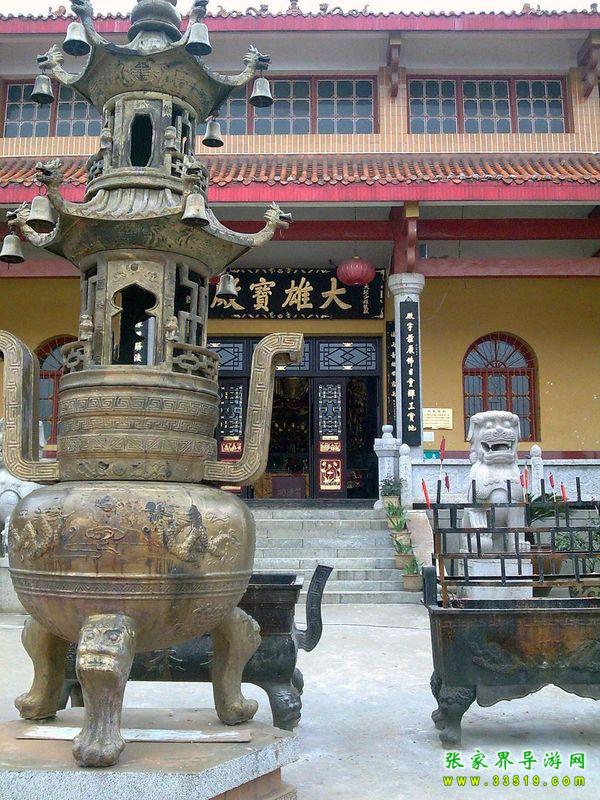
After the passing of the elderly Dharma Master Xiaochang, Dharma Master Weijing took up the staff of spreading the Dharma and benefiting sentient beings, continuing to lead the disciples in expanding the temple's scale. They built the Hall of Heavenly Kings, the Sutra Library, the Bell and Drum Towers, the Guanyin Pavilion, and halls for expounding sutras and explaining Buddhist teachings. Incense has grown ever more abundant, and visitors have increased sharply. Last year, Dajie Temple was rated a "Five-Good Religious Site" by the Provincial Religious Affairs Bureau. Dharma Master Weijing often humbly says: "The road ahead is long and far-reaching; I will search high and low."
Wulong Mountain has long been a place for scholars and literati of past dynasties to pursue learning and rest. In the late spring of the 20th year of the Guangxu reign of the Qing Dynasty (1894), due to internal strife and foreign invasion, the government was heading toward collapse, causing the people to suffer and live in misery. At that time, seven talented scholars—Qi Baishi, Wang Zhongyan, Luo Zhenwu, Luo Xingwu, Chen Fugen, Tan Ziquan, and Hu Lisan—discussed state affairs, wrote inspiring words, and freely expressed their aspirations. They often gathered at Dajie Temple on Wulong Mountain and founded the 'Longshan Poetry Society.' The society not only studied poetry, calligraphy, painting, and carving, but also carried out musical and chess activities. Qi Baishi served as its president, and it remained active for over five years. They were praised in the Jiangnan region as the 'Seven Masters of Longshan.' Wang Zhongyan once wrote two poems here titled 'Harmonizing with the Rhyme of Song'an at Longshan Temple':
I arrived late to the Double Ninth gathering, how many chrysanthemums remain by the hedge.
Detained by travel, I broke an old promise; in dreams of famous mountains I compose new poems.
Autumn deepens in the garden, my heart longs to return; frost and dew bring cold, known to my thin bones.
How laughable to toil so for what end; in vain the years pass in this sage-bright age.
Amid ten thousand valleys and a thousand peaks, a lone wisp of smoke locks the Brahma palace.
The immortal comes with no fixed abode; the crane has gone but left its traces.
Cloud shadows lie in quiet solitude; the bell's sound flies into the distant sky.
On the stone bed I pace and lean again, melancholy that it has long been sealed in dust.
In those years, Qi Baishi, as president of the society, refined his painting career and also studied poetry and prose. Through a thousand hammerings and a hundred temperings, he ultimately achieved greatness, becoming a master of a generation in our country's painting world, renowned at home and abroad.
The famous linguist, professor at Peking University, and Mao Zedong's esteemed teacher Li Jinxi, in his early years once lived in Dajie Temple, studying diligently through hard times, and achieved success through learning.
Li Peijing, one of Zeng Guofan's "Four Disciples," a native of Xiangtan County, once served as Guizhou Provincial Administration Commissioner and Jiangsu Governor in the Qing Dynasty. In his youth he also studied and practiced Buddhism at Wulong Mountain. His son Li Chengli also studied to the level of Hanlin scholar and wrote a stele inscription for Dajie Temple that has been passed down through generations; the stele inscription is still well preserved today.
The sacred land of Longshan, which produces outstanding people from a spiritually endowed place, not only gathered eminent Buddhist monks of past generations such as Hui'an, Yilun, and Cizhou, but also nurtured generation after generation of Confucian heroes in the Huxiang region.