This attraction introduction is compiled from historical materials in the "Zhangjiajie Tour Guide Network" (33519.com · Scenic Spots section). Ticket prices, opening hours, transportation, and contact information mentioned in the text may be outdated. Please refer to the latest official announcements from the scenic area before traveling; some content consists of historical background/cultural introductions and is for reference only.
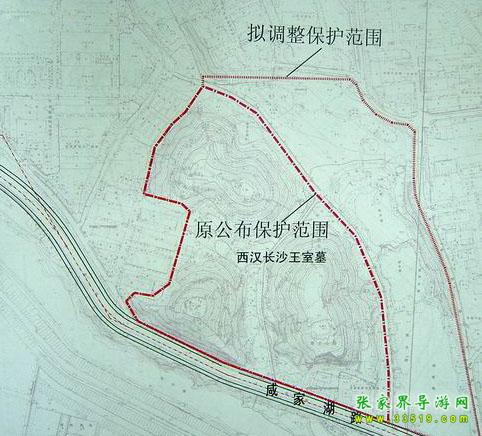
The Western Han Changsha Royal Tomb is a cultural relic protection unit of Hunan Province and one of the top ten new archaeological discoveries in China in 1993. It is located at Gufen Yuan, Wangchengpo, Changsha City. The tomb covers more than 10,000 square meters and consists of the main tomb and three burial pits arranged in a triangular formation around the main tomb. The tomb occupant is a certain queen of the Changsha Kingdom in the early Western Han Dynasty. From February to July 1993, the Office of the Changsha Municipal Cultural Relics Protection and Management Committee and the Changsha Municipal Cultural Relics Work Team excavated the tomb in coordination with the capital construction project of Hunan College of Finance and Economics.
The main tomb is a rock-pit vertical earthen shaft tomb with a sloping tomb passage and a wooden outer coffin chamber. It is 37 meters long, nearly 16 meters wide, and about 10 meters deep. It is divided into inner and outer coffin chambers. The outer coffin is surrounded on all sides by more than 400 thick, short timbers stacked in layers, enormous in scale, rigorous in structure, and magnificent in momentum, just like an underground palace of the Han Dynasty. The tomb consists of the ziggong, or coffin; the bianfang, or coffin chamber; the huangchang ticou, or short wooden blocks; and the waicangguo, or corridor. This complete burial system is precisely the system for the son of heaven mentioned in the Shiji and the Hanshu. The status of its tomb owner and the burial system are both above those of the Mawangdui Han tomb. Although this tomb had been robbed many times, more than 2,000 cultural relics of gold, jade, lacquer, pottery, and other categories were still unearthed. Among them, a large number of lacquerware are of great value for the in-depth study of objects from the early Western Han Dynasty. In particular, three five-string lacquered zhu were unearthed, the first discovery nationwide of physical examples of xianghe musical instruments from the pre-Qin and Han periods, which is of great significance for the study of the history of ancient Chinese music. Another writing implement unearthed from this tomb, a lacquer box inkstone long platform, is also called a rare treasure. The lacquer inkstone box is about 20 centimeters wide and 12 centimeters high. The inkstone stone is round and embedded in the lacquer box, with an ink block also placed at its side. The decoration is exquisite, the conception ingenious, and it is extremely rare, worthy of being called outstanding among Han inkstones.